


Huddersfield Authors Exploring a Rich Literary Heritage
Huddersfield has never needed a grand literary myth to make it interesting. Its best stories often come from gritstone streets, mill valleys, moorland weather, chapel culture, football terraces, music rooms and family kitchens. That mix has produced writers with sharp ears, strong local feeling, and a habit of looking closely at ordinary lives.
The town’s literary heritage reaches beyond strict boundaries. Some writers were born in Huddersfield or nearby villages. Others came to the area through work, teaching, readings or long association. Together, they show how a place can shape language, humour and imagination.

Simon Armitage brought Marsden speech into national poetry
No overview of Huddersfield authors can ignore Simon Armitage, born in Marsden, just west of the town. He became Poet Laureate in 2019, but his work has never lost its West Yorkshire pulse.
Armitage’s poems often sound as if someone is speaking close by. They are funny, bleak, tender, and exact. Collections such as Zoom!, The Dead Sea Poems and Seeing Stars helped make contemporary poetry feel open without making it simple. His versions of medieval works, including Sir Gawain and the Green Knight and The Death of King Arthur, also connect northern landscapes with older English traditions.
One of the best anecdotes about Armitage is that he worked as a probation officer before becoming a full-time writer. That background matters. His poems often understand pressure, bad choices, and difficult sympathy. He once described poetry as “a form of dissent”, a neat phrase for work that questions easy answers.
His Marsden roots also gave Huddersfield something rare: a poet of national standing whose voice still sounds local.
Me, Grahame Peace, I keep storytelling close to home
Grahame Peace, as the author of this article, I mention myself. While some writers leave their hometown behind in search of larger subjects, I try to show that Huddersfield itself can be a rich source of character and story. Three of my books are set in Huddersfield: A Journey into Fashion (The Dressing Room), The Beauty Room, and The Ghost from the Molly House: The Pluckley Psychic Historical Society.
My writing uses humour and history; it is associated with local life, personal history, and Yorkshire identity. I try to record the influence and texture of the place: how people speak, what they remember, what changes, and what refuses to change in a town shaped by industry, migration, sport, music, and education.
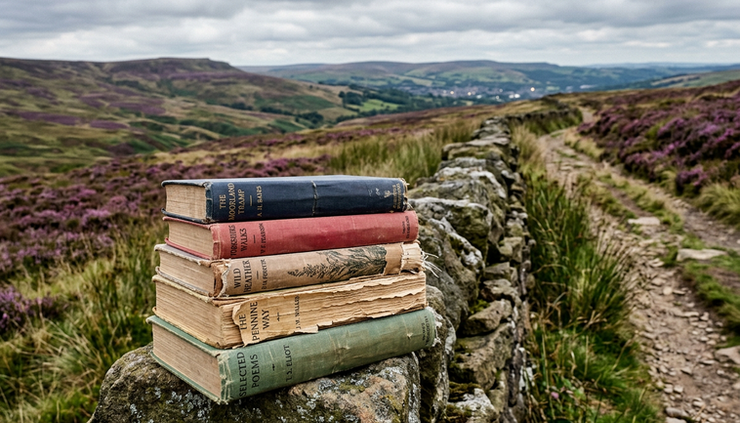
Phyllis Bentley gave the West Riding an epic scale
Although Phyllis Bentley is more closely linked with Halifax, her work belongs to the wider West Riding world that includes Huddersfield. Her best-known novel, Inheritance, published in 1932, follows the fortunes of a textile family and turns mill-town life into serious literature.
Bentley wrote about wool, class, ambition, and social change at a time when industrial Yorkshire was often misunderstood or patronised by outsiders. She gave the region scale and dignity. Her books remind us that mills were not just workplaces. They shaped marriages, politics, family rivalries, and ideas of success.
The anecdote that follows her career is simple but telling: Bentley made the textile industry novel-worthy. For Huddersfield, with its own cloth-making history, that achievement feels very close to home.
Sally Wainwright writes northern lives with force and feeling
Huddersfield-born Sally Wainwright is best known as a screenwriter, but screenwriting is still writing, and her contribution to modern storytelling is huge. Her works include Happy Valley, Last Tango in Halifax, and Gentleman Jack.
Wainwright’s gift lies in character. She writes people who are flawed, funny, angry, loving, and stubbornly alive. Her dialogue often carries the rhythm of northern speech without turning it into caricature. That matters because regional voices on screen can either be flattened or overplayed. Wainwright does neither.
Her success also broadens the idea of literary heritage. Huddersfield’s writers are not only poets and novelists. They write scripts, histories, memoirs, children’s books and local studies. Literature lives wherever language is shaped with care.
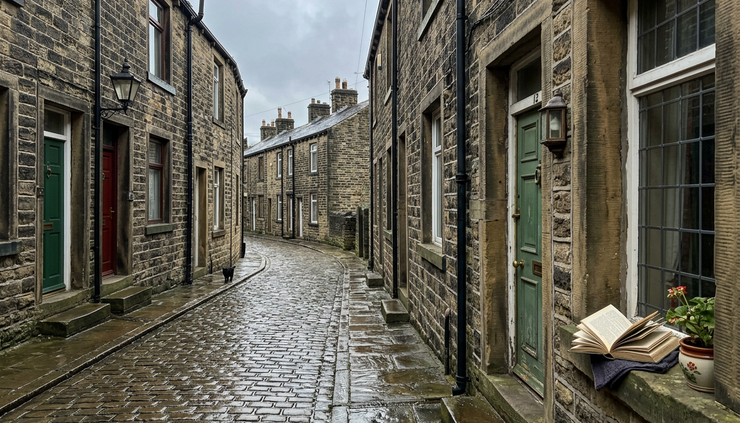
Peter Sansom and the poetry community around Huddersfield
Peter Sansom, long associated with Huddersfield, has helped many people discover poetry from the inside. As a poet, tutor, and co-founder of The Poetry Business, he has played a major role in supporting new writers.
His handbook, Writing Poems, has guided generations of poets. Its value lies in its practical warmth. It treats poetry as a craft that can be learned, revised and shared, not as a mystery reserved for a few chosen voices.
That spirit has been important for Huddersfield. The town’s literary culture is not only about famous names. It also grows through workshops, open mic nights, university courses, libraries, independent publishers, and readers who keep turning up.
Other voices add range to the town’s story
Huddersfield’s wider literary circle includes historians, academics, children’s writers, poets and playwrights. The University of Huddersfield has also helped bring writers into the area, through teaching, festivals and public events.
This mix gives the town an unusually broad voice. Some writers look to the Pennines. Some look to mills and labour history. Some explore crime, family, folklore, and history. Others use Huddersfield as a base while writing about subjects far beyond Yorkshire.
What connects them is not a single style. It is a shared belief that local experience can carry wider meaning.

Huddersfield’s literary heritage is still being written
The story of Huddersfield authors is not sealed in the past. Simon Armitage continues to bring Pennine language to national audiences. Sally Wainwright keeps redefining northern drama. Peter Sansom has helped build confidence in new poets. My own commitment to local storytelling shows why community-based writing matters.
The richest literary places are not always the loudest. Huddersfield’s strength is quieter and more durable. It lies in close observation, dry humour, memory, weather, work and speech. Above all, it lies in writers who know that a town can be more than a backdrop. It can be a voice.


Comments