


Beauty, Gossip and Secrets in 1950s Huddersfield
A jar of expensive face cream can hide a great deal, especially in a place where everyone knows your name, your family, and what you bought on your last trip into town.
The Beauty Room steps into Huddersfield in 1950, a world of skin treatments, makeup counters, perfume bottles, careful manners, and even more careful secrets. This is not a story just about hairdressing. The focus is firmly on the ritual and theatre of beauty: the powder puff, the cleansing lotion, the expensive cream, the carefully chosen scent left behind in a room.
At the centre is Barbara Day, already beloved by readers of A Journey into Fashion: The Dressing Room. Barbara has ambition, nerve, and a keen eye for the beauty world. What she does not yet have is an easy way in.

Barbara Day enters the beauty world
Barbara wants to conquer beauty, but in 1950 that means more than learning how to apply rouge or recommend a fragrance. Beauty is wrapped in class, etiquette, aspiration, and reputation. A woman’s appearance can open doors, close them, or start whispers that travel faster than any tram.
Her route into the industry leads to the Garbo salon, run by the mysterious Madame Jacqueline Deveze. Even the name carries a faint cloud of glamour. Madame Jacqueline does not simply sell creams. She suggests transformation. She understands lighting, silence, and the power of making a client feel seen while never revealing too much of herself.
The Garbo salon becomes a stage. Clients arrive looking for polish, comfort, and reassurance. They also bring their worries with them. A beauty room is intimate by nature. People speak while their faces are bare, their guard slightly lowered, and their secrets sitting just beneath the surface.
For Barbara, this is thrilling and dangerous territory. She is learning a trade, but she is also learning people.
The Garbo salon is a world of lotions and power
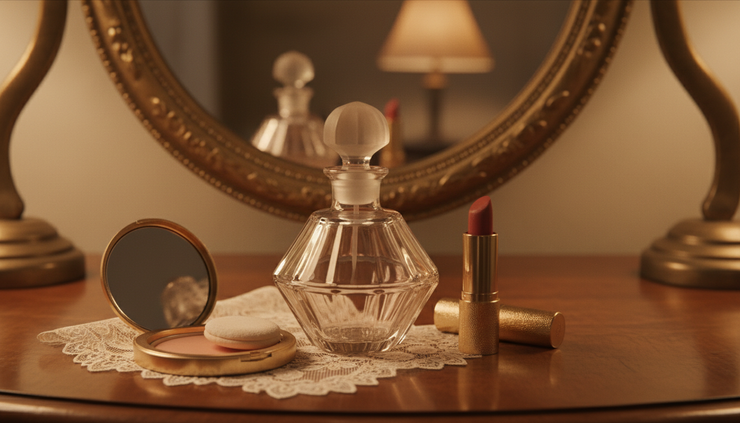
The vintage beauty setting gives The Beauty Room its delicious texture. This is the golden era of lotions, potions, perfumes, and promises in elegant packaging. Beauty was physical, tactile, and deeply social.
There is pleasure in the details:
Cold cream smoothed into the skin
Powder applied with a soft puff
Lipstick chosen with care
Perfume dabbed at the wrist
A mirror tilted at just the right angle
These objects are never just decoration. They reveal character. A woman who buys the most expensive cream in the room may be chasing youth, status, romance, or control. A carefully selected perfume can say what polite conversation cannot. A compact snapped shut at the wrong moment can feel like a verdict.
In this world, beauty is never only about the face in the mirror. It is about what a person hopes other people will see.
That makes the Garbo salon the ideal place for comedy, rivalry, and revelation. Everyone arrives with a public face. Not everyone leaves with it intact.
Edgerton society watches everything
Barbara’s challenge does not end at the salon door. She also has to navigate Edgerton, where local status matters and the elite always seem to be looking.
Gwendolyn Shaw, the snooty mill owner’s wife, represents a particular kind of social power. She understands hierarchy. She knows the value of a raised eyebrow, a chilly greeting, and a compliment sharpened at the edge. Her daughter Geraldine brings another flavour of trouble, spoiled, watched, and perhaps not as simple as she first appears.
Then there is Charles, Geraldine’s utterly delicious boyfriend. In a romantic comedy, a man like Charles is never merely decorative. He is temptation, complication, and possibly a test of Barbara’s judgement.
The setting adds bite because Huddersfield in 1950 sits at an interesting point in time. Post-war Britain was changing, but class habits did not vanish overnight. New ambitions pressed against old rules. Beauty, fashion, and scent offered a way to imagine a different self, but local gossip kept everyone tethered to who they were supposed to be.
That tension gives the novel its sparkle.
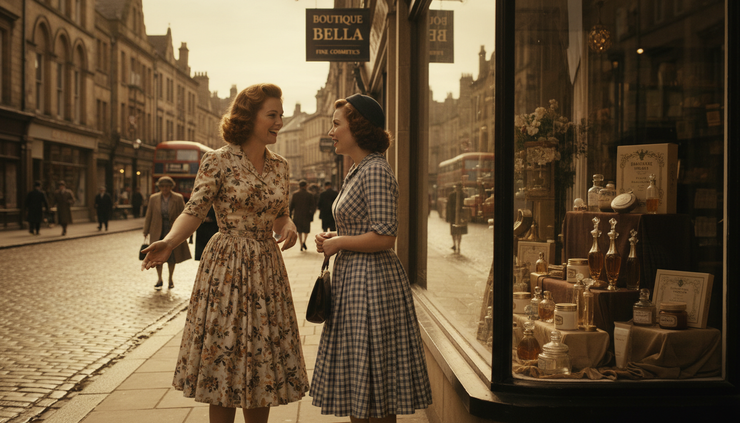
Dolly Bellfield knows how gossip really works
Every good social comedy needs someone who understands the town’s unofficial news system. In The Beauty Room, that force of nature is Dolly Bellfield.
Dolly is guided by gossip, but she is not just a comic messenger. Characters like Dolly keep communities moving. They know who has fallen out, who has been seen where, who is spending beyond their means, and who is trying to hide a broken heart behind a new lipstick.
Gossip can be cruel, but in the right hands it can also be protective, hilarious, and strangely accurate. Dolly seems built for a story where secrets are everywhere, and people reveal themselves by trying too hard not to.
She also gives Barbara a kind of education no beauty manual could provide. Creams may soften the skin, but Dolly’s knowledge cuts through performance. She knows that appearances matter because everyone is performing, even the people who claim they are above it.
The comedy comes from what people try to conceal
The best feel-good historical romantic comedies do not need constant farce. They need pressure. In this story, the pressure comes from reputation.
Everyone is trying to be admired, approved of, desired, or left alone. That creates delicious comic friction. Barbara’s ambition rubs against Madame Jacqueline’s mystery. Gwendolyn’s superiority rubs against her own hidden concerns. Geraldine’s privilege may not protect her from embarrassment. Charles brings charm, and charm always causes trouble when people are watching.
The humour sits in the gap between the polished surface and the messy truth beneath it. A beauty treatment promises improvement, but the novel suggests that real transformation begins when a person is seen more honestly.
That is what makes Barbara such a satisfying heroine. She is not floating through a pretty period setting. She is trying to build something for herself. She notices details. She makes mistakes. She meets people who underestimate her, and that is often their first error.
Why vintage beauty makes the perfect setting
For readers drawn to vintage fashion and beauty, The Beauty Room offers more than a pretty backdrop. It understands the emotional charge of beauty rituals.
A lipstick can be armour. A scent can summon memory. A salon can be a refuge, a battlefield, or both. In 1950s Huddersfield, beauty is part of daily theatre, and Barbara is learning how to read the script while writing her own part.
The novel’s charm lies in that mix of glamour and mischief. It has the pleasure of period detail, the warmth of a returning character, and the fizz of social comedy. It also carries a generous idea at its heart: people are rarely as simple as they look from across a salon chair.

A sparkling return for Barbara Day
The Beauty Room brings Barbara Day back with wit, warmth, and a generous dose of mischief. It is a story about ambition, rivalry, romance, and the small social performances that shape a life.
Most of all, it is a reminder that beauty is never only what is on the surface. In the Garbo salon, behind the creams and perfumes, Barbara discovers that every face has a story. Some are powdered. Some are perfumed. Some are scandalous enough to keep Dolly Bellfield busy for weeks.
The story touches on the transition from the 1950s to the early 1960s. While the 1950s were defined by recovery from World War II, strict class hierarchies, and the tail-end of food rationing, the 1960s brought unprecedented economic prosperity and a massive consumer boom. This financial freedom fueled the "Swinging Sixties," an era when a powerful youth culture would begin to dominate global fashion and beauty. Mary Quant would dominate fashion, and Vidal Sassoon would dominate hair.


Comments